


BenchPrep course content can be manually created or imported in through our import tool You can also replicate course content from an existing course. To learn more about replication, click here. BenchPrep courses give you the flexibility to create flashcards, questions, assignments, practice tests, and upload assets within BluePrint. Remember, unlike Asset-Based courses, you cannot create your content within a course authoring tool and import. All content is created within the BluePrint application.
To create a BenchPrep Course in BluePrint:
-
Click Courses on the left side menu
-
Click Create a Course on the right hand side
-
Select Asset-Based Course or BenchPrep Course
-
After selecting either course type, fill in the required details and click Create a Course on the lower right hand side
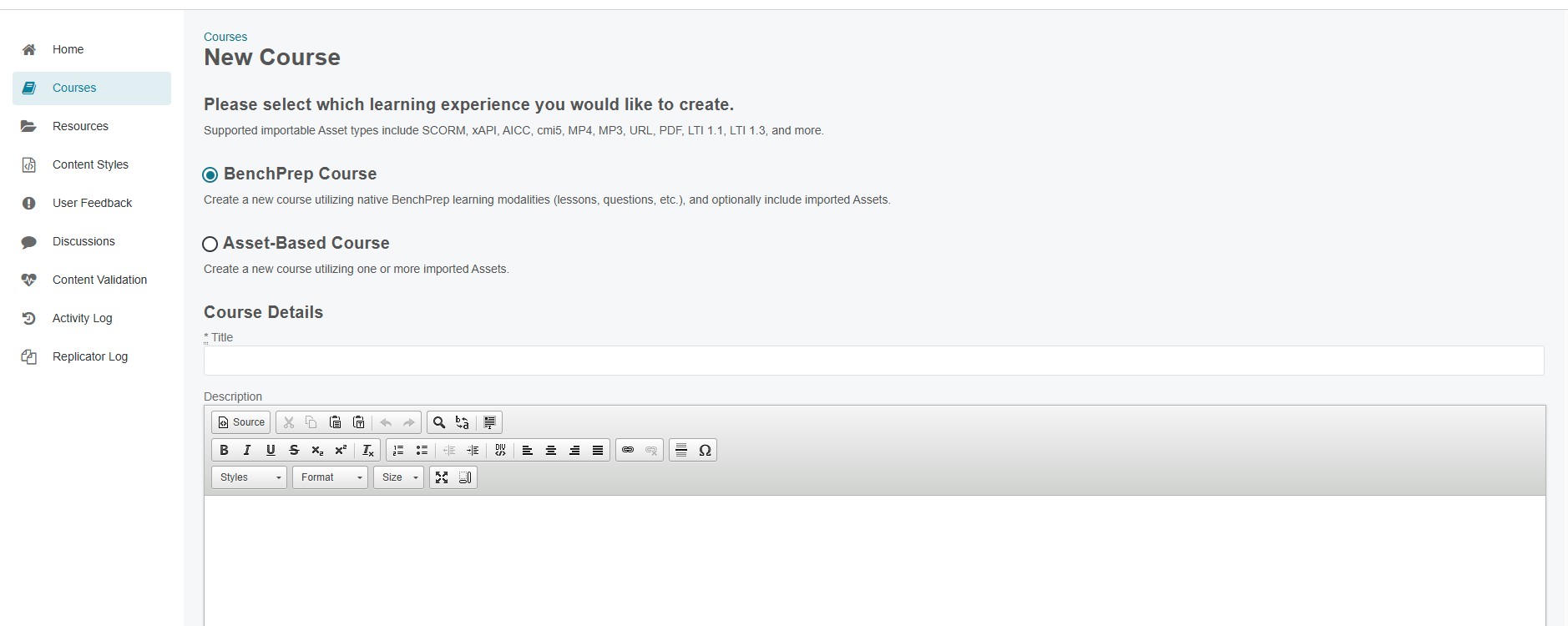
Course Details
|
Title |
The title of the course is the name of your course. For example: Exam Practice. |
|
Description |
Optional field however, recommended. Describe your course. |
|
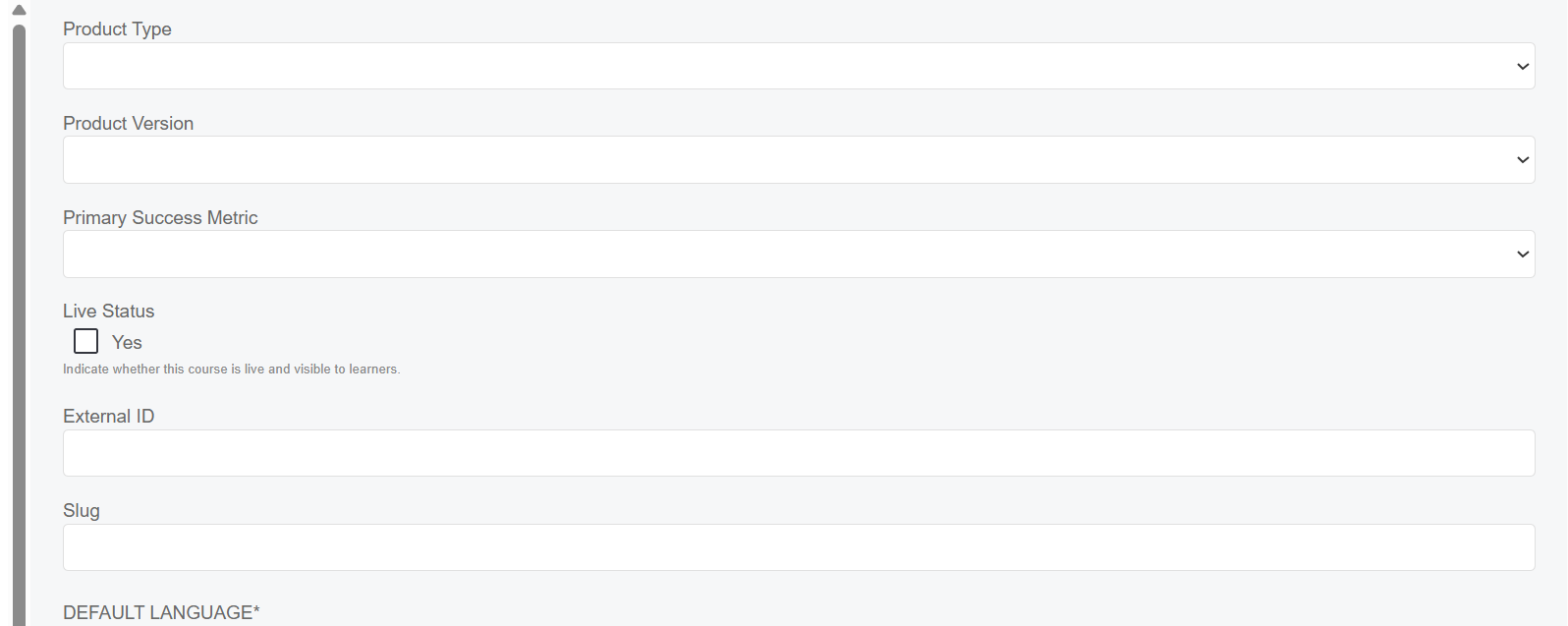
Product Type |
This field identifies the primary category or purpose of this learning product. Select the option that best describes the learner experience or intended use of the course (for example: Exam Prep, Continuing Education, Credential, or Other). This field is used for internal classification purposes only and is not surfaced to learners. This field is optional during course creation but required before publishing the course to learners. |
|
Product Version |
This field identifies whether the course is being created as a brand-new learning product or as a new version of an existing product. Select New Product when creating a course that does not already exist in the platform, or New Version when creating an updated iteration or release of an existing course. This field is used for internal product management purposes only and is not surfaced to learners. This field is optional during course creation but required before publishing the course to learners. |
|
Primary Success Metric |
This field identifies the main business or learner outcome the course is intended to achieve. Select the option that best represents the primary measure of success for this learning product (for example: Revenue, Learner Satisfaction, Course Completion, Lead Generation, or Other). This field is used for internal reporting and product management purposes only and is not surfaced to learners. This field is optional during course creation but required before publishing the course to learners. |
|
Live Status |
This field identifies whether the course is currently live for learners. This field is used for internal reporting and product management purposes only and is not surfaced to learners. This field is optional, and we recommend enabling it once the course is live. |
| External ID | Add an external course id to your course (optional) |
|
A course slug is a required course identifier that is visible to end learners. Course slugs are configurable and appear at the end of the course URL. In order to ensure learners only access the courses they’re authorized to use, each course’s course slug must be unique. The below screenshot shows one course slug and where this slug appears in the course URL. By default, a course’s slug is the name of the course, adjusted to meet standard URL syntax guidelines. For example, if you create a course named “Sample Course 123,” the default course slug will be “sample-course-123.” Users with the BluePrint Admin role can change course slugs after course creation. Enter the URL here. |
|
|
Is it a Bank? |
A bank contains your course content and where you go for content changes. We recommend checking this box if you are creating a single source of content for updating other courses. Note: A Bank cannot be published for use by learners. Click here to learn more about Banks. |
|
This option presents answer choices next to the answer content (ex: B. Answer content) and only works with multiple-choice questions (single and multiple-answer). It also lets you give a different answer rationale for each answer choice. Once selected, you cannot turn off the setting. We recommend you use this setting if your content meets the requirements and will never not meet the requirements. Meaning, you don’t plan on adding questions that are not multiple choice. |


